4 · Research and Meaning: Matter and the Memory of Time
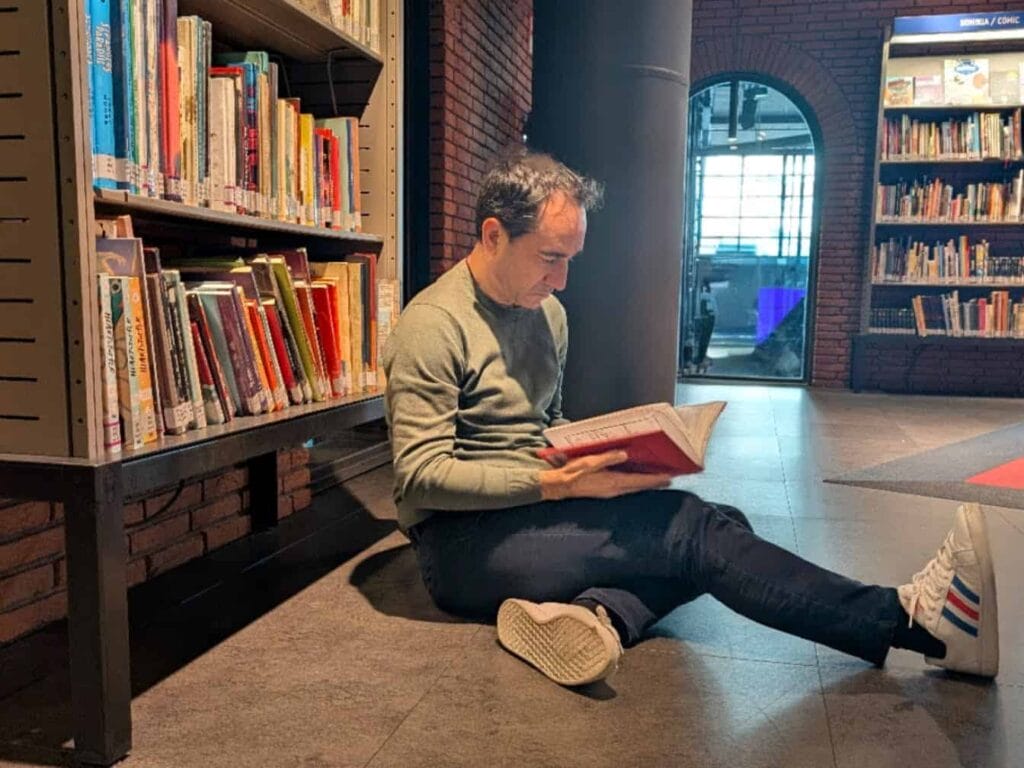
Some pieces demand a framework that transcends intuition; they require a dialogue with time and science. My research process is the bridge between raw emotion and the final work. While the smartphone is an indispensable tool for immediate inquiry, my true center of gravity is the library. To me, it is a vital space for ritual and focus. I don’t just go there for information; I go for the touch of paper and the weight of an old book. I firmly believe that consciousness remains embedded in the objects we use: the maturity of the scholar or the curiosity of the student. Absorbing that “magic” while working on-site allows me to connect with a collective wisdom that I later strive to pour onto the canvas.
In my search for meaning, science, architecture, and philosophy set the pace. I am obsessed with cutting-edge physics: black holes, wormholes, and the fourth dimension as an absolute whole. This fourth dimension directly influences my vision; I do not paint a static object, but rather attempt to see the piece through all its phases, from birth to its transformation into something else. I investigate how others have explored these spatial anomalies, seeking roots for my own vanishing lines.

This process also has a tactile side. I collect objects—rocks, shells—with textures that challenge me. However, I often choose to let the physical object go. The loss of the object is deliberate: I seek the simplification of a curve or the essence of an anomaly. I memorize the form and play with its variables in my mind, imagining how it would fit into the painting’s balance. Often, I discard beautiful shapes because they do not serve the harmony of the whole. In this struggle, contradiction often wins, remaining in the work as a testament to the process.

I view my paintings as living beings that need their own time and place to mature, much like the stages of human development. Color is not a whim; it is a technical tool necessary to express the order behind the chaos. The end of the process is not a rational decision but a physical state: a sense of calm, relief, and finally, the ecstasy of fulfillment. At that moment of apparent equilibrium, my inner voice tells me: “You have it. Don’t touch it.” The work has ceased to be an investigation and has become an autonomous being that will age alongside the viewer.
