5th Avenue: Power, Geometry, and the Illusion of Structure
There are places in New York where the city reveals itself without disguise.
5th Avenue is one of them.
It is often described through luxury, commerce, and global recognition. But beyond its surface, 5th Avenue is something far more essential: a vertical system of power, repetition, and controlled perception.
This is where my work connects.
The vertical city as abstraction
Unlike the underground chaos of the subway, 5th Avenue is defined by elevation. Everything rises. Everything points upward.
Glass. Steel. Concrete.
From a distance, it feels ordered. Structured. Almost perfect.
But when you isolate its elements, what you see is something else entirely:
a network of lines under tension, constantly competing for dominance in space.
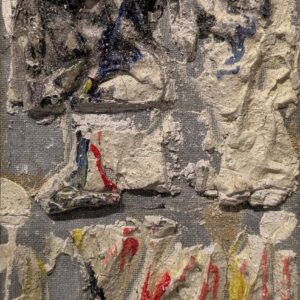
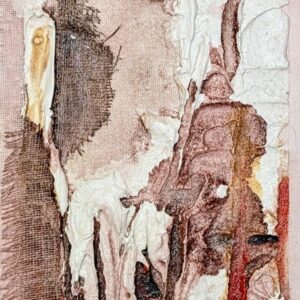
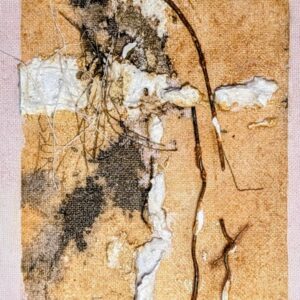
In my paintings, I reduce this environment into vertical forces and compressed geometries, where balance is never fully stable.
The viewer is not observing buildings.
They are confronting direction, pressure, and scale.
Architecture as psychological control
5th Avenue is not just physical. It is psychological.
The height of buildings, the reflections on glass, the symmetry of facades — all of it creates a controlled experience. You are guided without realizing it. Directed upward. Contained within a visual order.
This is why I approach it not as architecture, but as perceptual design.
In my work, this translates into:
- Rigid vertical strokes, suggesting imposed structure
- Reflective layers, echoing glass surfaces and distortion
- Sharp contrasts, reinforcing hierarchy and separation
The result is an abstract field where control is visible — but not entirely stable.
Luxury and emptiness
There is a contradiction at the core of 5th Avenue.
It represents wealth, exclusivity, global identity.
And yet, emotionally, it can feel completely empty.
People pass through it, but rarely belong to it.
This duality — presence without attachment — is something I explore through spatial tension in my paintings.
Large empty areas coexist with dense structural lines.
Visual weight is uneven.
Nothing truly settles.
Because 5th Avenue is not about inhabiting space.
It is about projecting an image.
New York contemporary art and urban structure
In the context of New York contemporary art, architecture has always played a central role. But often, it is represented.
My approach is different.
I am not interested in painting buildings.
I am interested in extracting their underlying logic.
What defines 5th Avenue visually is not its identity as a street, but its repetition of vertical dominance.
That repetition becomes a language:
- Lines extending beyond the frame
- Surfaces that reflect but do not reveal
- Structures that appear stable but are internally fragmented
This places the work within a dialogue between minimalism and urban abstraction, rooted in the experience of New York rather than its image.
The role of reflection
Glass is one of the defining materials of 5th Avenue.
But glass does not simply show.
It distorts. It duplicates. It fragments reality.
When you walk through the avenue, you are constantly seeing multiple versions of the same space — overlapping, shifting, unstable.
This is crucial.
Because perception itself becomes unreliable.
In my paintings, I translate this through:
- Layered transparencies
- Interrupted lines
- Visual echoes that never align perfectly
The viewer is placed in a state of subtle disorientation.
Not enough to break the image — but enough to question it.
Scale and human disappearance
One of the most striking aspects of 5th Avenue is scale.
The human figure becomes secondary. Almost irrelevant.
Buildings dominate. Lines dominate. Space dominates.
This imbalance is something I deliberately push further in my work.
There is no central subject.
No human reference point.
Only structure.
This creates a different kind of tension:
the viewer is present, but cannot locate themselves within the composition.
Which reflects the experience of the avenue itself.
Positioning: Abstract art inspired by New York architecture
From a positioning perspective, this body of work aligns with:
- Abstract architectural art
- Urban minimalism in New York
- Contemporary interpretations of city structure
But more importantly, it speaks to a specific audience:
collectors and viewers who recognize New York not as an icon, but as a system of forces.
This is key for SEO and market positioning.
Because “New York art” is saturated.
But concept-driven, structurally abstract New York art is far more defined — and valuable.
From control to instability
At first glance, 5th Avenue appears controlled.
But nothing in New York is ever fully stable.
Reflections shift. Light changes. Movement disrupts structure.
And that is where the work lives.
In the moment where control begins to break.
In the subtle instability beneath perfect lines.
My paintings capture that threshold —
where order exists, but cannot sustain itself completely.
Conclusion: The illusion holds, until it doesn’t
5th Avenue is an illusion that works.
Until you look at it differently.
Until you reduce it to lines, reflections, and pressure.
Then, what seemed solid becomes fragile.
What seemed ordered becomes tense.
And what seemed complete reveals itself as something unfinished.
That is the space I work in.
Between structure and collapse.
Between image and reality.
Between what New York shows —
and what it actually is.